1.
I built a house
of Styrofoam
To keep the
harbour safe
2.
I built a spire
To light the night
It floated
far away
Commentary by Father Seth H. Gouli, PhD
To begin, most experts agree on the following two points:
1. The Author is providing some sort of political commentary on deregulation
of the construction industry, and perhaps deregulation in general.
2. Part two provides a clear and dire warning against said deregulation.
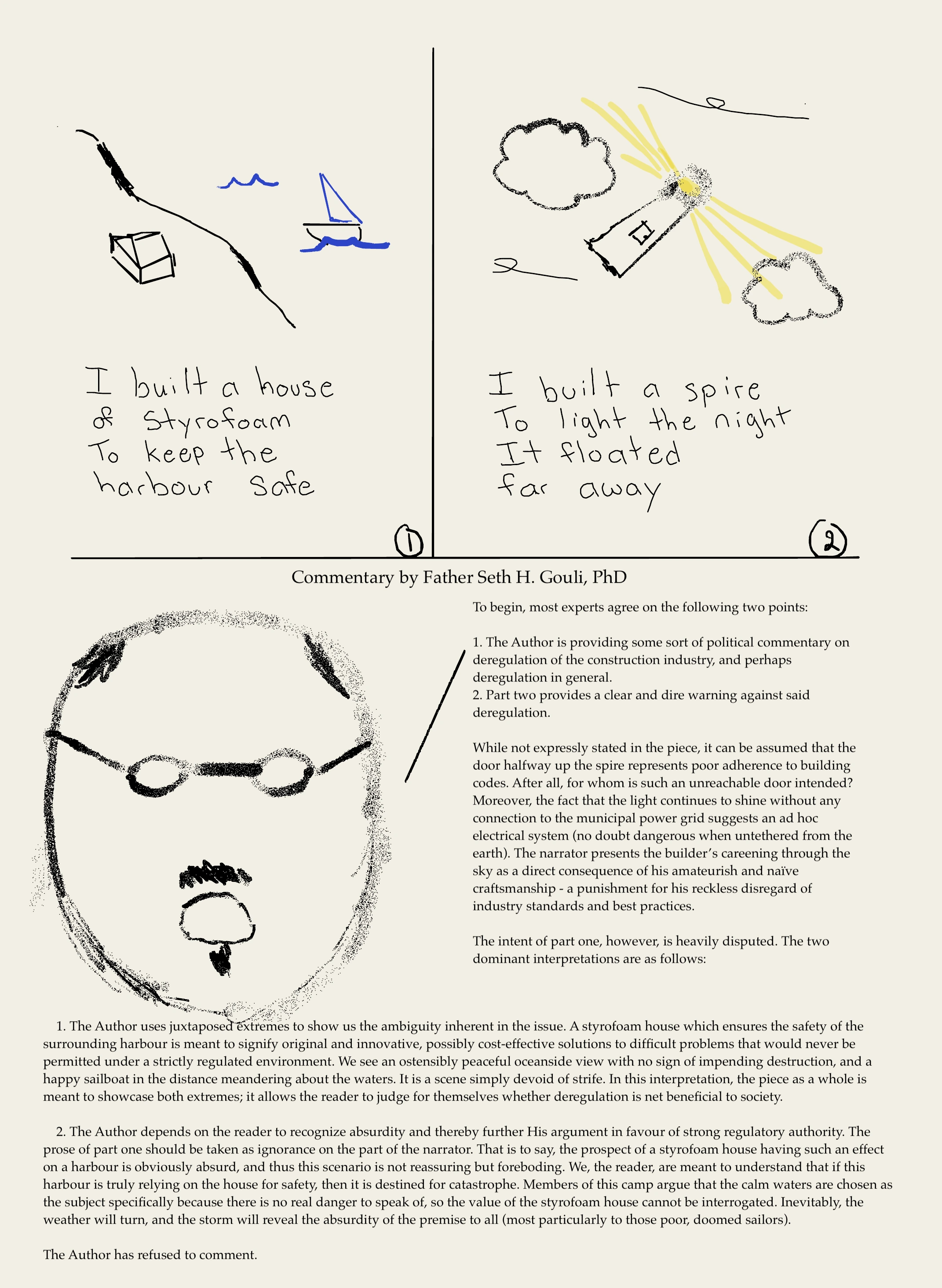
While not expressly stated in the piece, it can be assumed that the door
halfway up the spire represents poor adherence to building codes. After all,
for whom is such an unreachable door intended? Moreover, the fact that the
light continues to shine without any connection to the municipal power grid
suggests an ad hoc electrical system (no doubt dangerous when untethered from
the earth). The narrator presents the builder's careening through the sky as a
direct consequence of his amateurish and naïve craftsmanship - a punishment
for his reckless disregard of industry standards and best practices.
The intent of part one, however, is heavily disputed. The two dominant
interpretations are as follows:
1. The Author uses juxtaposed extremes to show us the ambiguity inherent in
the issue. A styrofoam house which ensures the safety of the surrounding
harbour is meant to signify original and innovative, possibly cost-effective
solutions to difficult problems that would never be permitted under a strictly
regulated environment. We see an ostensibly peaceful oceanside view with no
sign of impending destruction, and a happy sailboat in the distance meandering
about the waters. It is a scene simply devoid of strife. In this
interpretation, the piece as a whole is meant to showcase both extremes; it
allows the reader to judge for themselves whether deregulation is net
beneficial to society.
2. The Author depends on the reader to recognize absurdity and thereby further
His argument in favour of strong regulatory authority. The prose of part one
should be taken as ignorance on the part of the narrator. That is to say, the
prospect of a styrofoam house having such an effect on a harbour is obviously
absurd, and thus this scenario is not reassuring but foreboding. We, the
reader, are meant to understand that if this harbour is truly relying on the
house for safety, then it is destined for catastrophe. Members of this camp
argue that the calm waters are chosen as the subject specifically because there
is no real danger to speak of, so the value of the styrofoam house cannot be
interrogated. Inevitably, the weather will turn, and the storm will reveal the
absurdity of the premise to all (most particularly to those poor, doomed
sailors).
The Author has refused to comment.